
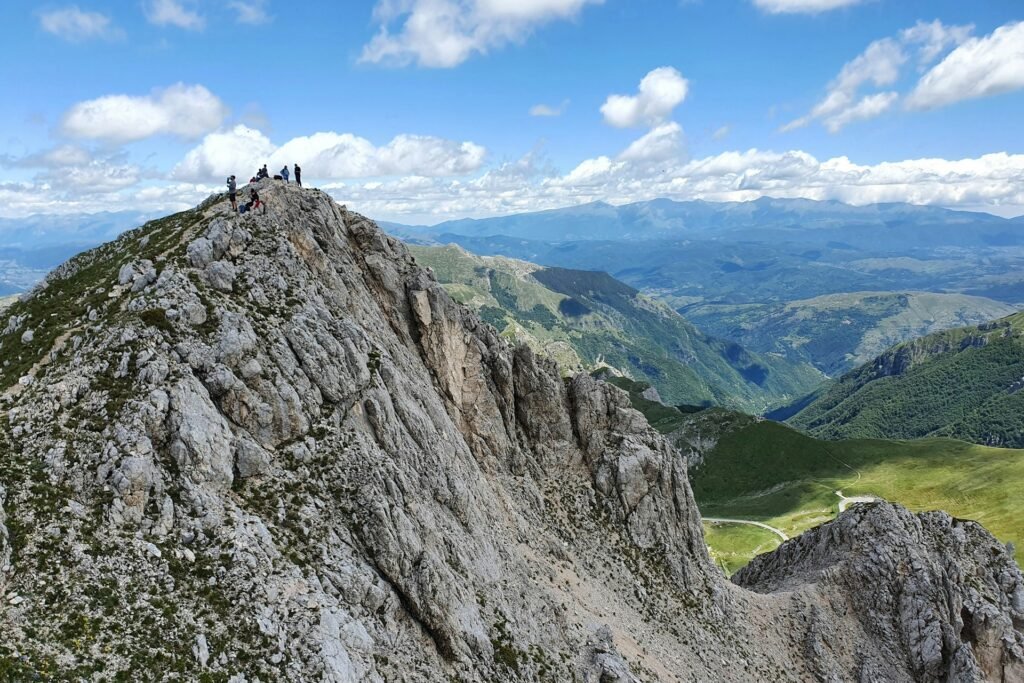
The Carpathian mountains rise dramatically from the edges of Brașov, offering some of the most spectacular hiking in all of Europe. Yet compared to the Alps or the Dolomites, they remain refreshingly uncrowded — especially in autumn, when the forests turn gold and the trails belong almost entirely to those who know where to look.
Whether you’re an experienced trekker or stepping onto a mountain trail for the first time, the Carpathians have a route for you. Here are the trails we recommend most — and why autumn is the best time to walk them.
Bucegi Mountains: The Classic Carpathian Experience
The Bucegi plateau is the most iconic hiking destination near Brașov, and for good reason. The landscape shifts dramatically as you climb — dense beech forests give way to open alpine meadows, and then to the bare, wind-scoured plateau where the views stretch for hundreds of kilometres on a clear day.
The Sphinx and Babele Route
This is the trail most visitors attempt first, and it rarely disappoints. The route takes you past two of Romania’s most famous rock formations — the Sphinx, a naturally sculpted rock that bears an uncanny resemblance to its Egyptian namesake, and Babele (the Old Women), a cluster of mushroom-shaped stones shaped by millennia of wind erosion.
The trail is accessible from Bușteni via cable car, making it manageable even for those without a high level of fitness. From the plateau, you can extend the walk in several directions depending on how much time and energy you have.
- Best for: First-time Carpathian hikers, families, and those short on time.
Caraiman Peak (2,384 m)
For those who want a proper summit, Caraiman offers one of the most rewarding climbs in the Bucegi range. The trail from Bușteni gains significant elevation, but the path is well-marked and the effort is repaid with panoramic views across the Prahova Valley and deep into the Transylvanian plateau.
At the summit stands the Caraiman Heroes’ Cross — a 28-metre iron cross erected in 1928 as a memorial to Romanian soldiers who fell in the First World War. It’s a striking sight against the open sky, and one of the most photographed landmarks in the Carpathians.
- Best for: Confident walkers looking for a full-day summit hike.
Omu Peak (2,505 m)
Omu is the highest point in the Bucegi range and a serious undertaking. The route from Bușteni takes a full day and requires good fitness, appropriate footwear, and — crucially — a guide who knows the mountain. Weather on the plateau can change rapidly, and the trails above the treeline are exposed.
With a guide, however, Omu is an extraordinary experience. The summit meteorological station has been staffed continuously since 1882, and on a clear autumn day the views are simply extraordinary.
- Best for: Experienced hikers with a full day and a certified guide.
Piatra Craiului: The Limestone Ridge
If Bucegi is the Carpathians’ most famous range, Piatra Craiului is its most dramatic. The name means “King’s Rock,” and the 25-kilometre limestone ridge that forms the park’s spine is one of the most distinctive landforms in Romania — a narrow, serrated crest rising to 2,238 metres, visible from Brașov on a clear day.
The Main Ridge Trail
The full ridge traverse is a multi-day undertaking, but the approach trails from the village of Zărnești offer spectacular day hikes that take you deep into the park without committing to the full route.
The trail through the Zărnești Gorge is a particular highlight — a narrow limestone canyon where the walls rise sheer on either side and the path threads between boulders and through patches of ancient forest. It’s one of the most atmospheric walks in the Carpathians, and it takes less than two hours from the trailhead.
- Best for: Hikers who want dramatic scenery without a full-day commitment.
La Om (2,238 m)
The highest point of Piatra Craiului is a serious mountain objective. The ascent from the valley is long and steep, and the final section along the exposed ridge requires care and a head for heights. But the views from the summit — across the Bucegi to the east, the Făgăraș to the south, and the Transylvanian plateau to the north — are among the finest in Romania.
This is a trail that rewards those who take it with a guide. The ridge is narrow in places, the weather can deteriorate quickly, and route-finding in mist requires local knowledge.
- Best for: Experienced mountain walkers accompanied by a certified guide.
Why Autumn Is the Best Season to Hike the Carpathians
Spring and summer have their appeal, but autumn is when the Carpathians are at their most beautiful — and most practical for hiking:
- The colours: From mid-September through October, the beech and oak forests covering the lower slopes turn vibrant shades of amber, copper, and gold. The contrast between golden canopies and grey limestone peaks is striking.
- The crowds: Summer draws heavy visitor traffic to cable cars and lookout points. By September, trails clear significantly, and mountain huts become quieter and more welcoming.
- The conditions: Summer heat can make low-elevation ascents arduous, and afternoon thunderstorms are frequent in July and August. Autumn delivers cooler, more stable weather ideal for sustained walking.
- The light: A lower sun angle creates exceptional photography conditions, offering prolonged golden hours and warm evening light on the ridges.
What to Bring on a Carpathian Day Hike
Even on a well-marked trail with a guide, mountain terrain demands preparation:
- Footwear: Proper hiking boots with ankle support. Trail runners are acceptable on lower routes, but not on rocky ridge trails.
- Layers: Weather shifts rapidly at elevation. Pack a waterproof shell, an insulating mid-layer (fleece or down), and a breathable base layer regardless of the forecast.
- Water: At least 2 litres per person. Mountain springs exist on certain routes, but flow rates vary.
- Food: A substantial packed lunch and energy-dense trail snacks.
- Navigation: Downloaded offline maps (such as Maps.me or Gaia GPS). Cellular reception is unreliable along high ridges.
- Sun protection: High-altitude UV exposure remains strong well into the autumn months.
Hiking with a Guide vs. Going Alone
Carpathian trails feature marked trail blazes, and experienced hikers frequently tackle them independently. However, local expertise provides distinct advantages:
- Safety & Navigation: Certified guides monitor localized weather patterns, select safe bypass routes following rain, and carry wilderness first-aid equipment.
- Summit Routes: For technical or exposed summits—such as Omu, La Om, and the Caraiman ridge—having a guide mitigates the risks of sudden cloud cover or route disorientation.
- Local Insight: Beyond pathfinding, local guides share regional history, folklore, and geology, contextualizing the landscape throughout the trek.
Plateau walks and valley gorges remain accessible to independent hikers with solid navigation skills, while technical ridgelines are best approached with professional support.
Book Your Carpathian Hike This Autumn
Our Carpathian Hiking tour is now open for the season. To celebrate the launch, we are offering an introductory rate for reservations made before 10 October.
Tours run as full-day guided excursions in small groups (maximum eight people), departing daily from central Brașov.