
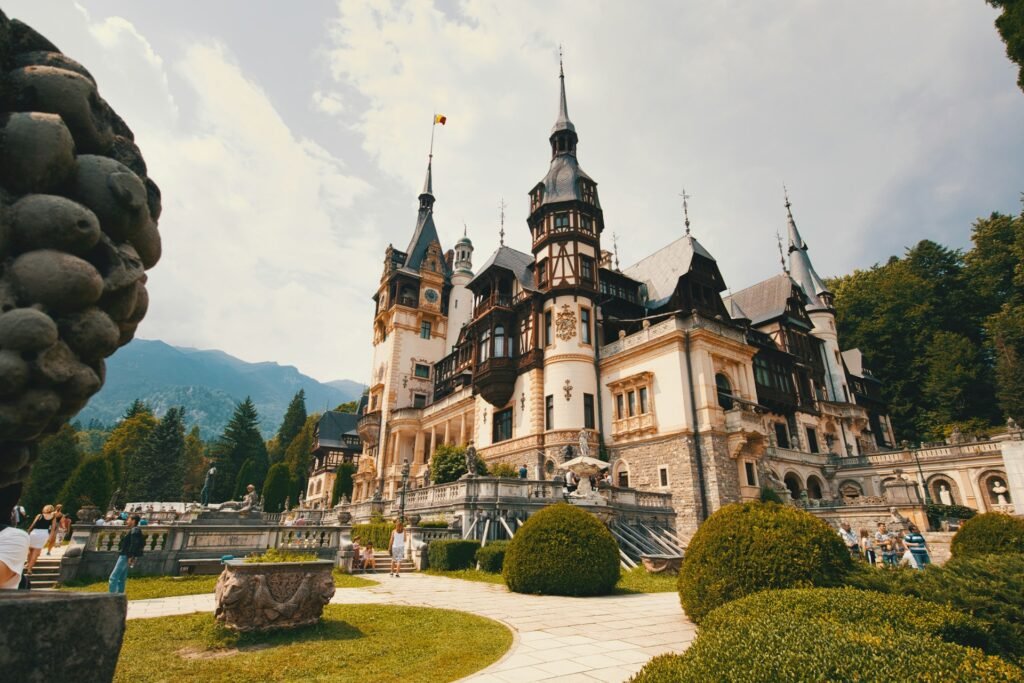
Peleș Castle in Sinaia is one of those places that exceeds expectations even when your expectations are already high. Built between 1873 and 1914 as the summer residence of King Carol I, it is one of the most lavishly decorated palaces in Europe — and one of the least known outside Romania. If you’re visiting for the first time, here’s everything you need to know.
Getting There
Sinaia is about 50 kilometres from Brașov, in the Prahova Valley on the southern edge of the Carpathian Mountains. By car, the drive takes around 45 minutes via the DN1 road through Predeal and Bușteni — a scenic mountain route with views of the Bucegi massif.
The most convenient option for most visitors is a guided day tour from Brașov, which combines Peleș with Bran Castle, Sinaia Monastery, and Cantacuzino Castle in a single full day. You get return transport, skip the parking headache, and arrive with a guide who knows every room and every story.
How Long to Allow
The standard guided tour of Peleș covers the ground floor and first floor — roughly 35 rooms — and takes about 45 minutes to an hour. If you want to explore at your own pace with an audio guide, allow 1.5 to 2 hours. The exterior and terraced gardens alone are worth 20–30 minutes.
There is also Pelișor Castle nearby — a smaller, Art Nouveau residence built for Crown Prince Ferdinand and Queen Marie — which adds another 45 minutes if you have time.
The Rooms Not to Miss
The Hall of Honour: Your first impression of the interior — a soaring three-storey atrium with carved walnut panelling, stained-glass skylights, and a monumental staircase. This is the room Carol I designed to impress visiting heads of state, and it still works.
The Moorish Salon: One of the most extraordinary rooms in the palace. Step through the doorway and the Neo-Renaissance palace transforms entirely — walls covered in intricate tilework, a honeycomb ceiling of carved plasterwork, furniture inlaid with mother-of-pearl and ivory. Carol I was fascinated by Islamic art, and this is his most extravagant expression of that interest.
The Theatre Hall: Peleș has its own private theatre, with frescoes commissioned from the workshop of Gustav Klimt — painted during his early career, before he developed the gold-leaf style that made him famous. These are among the least-known Klimt works in existence.
The Armoury Halls: Carol I was a passionate collector of weapons and military history. The armoury displays one of the finest collections of medieval and Renaissance arms in southeastern Europe, including a 16th-century Ottoman sword captured at the Battle of Plevna.
The Royal Study: This is where Carol I governed Romania for 48 years. Intimate and functional, lined with books and maps, yet finished to the highest standard. The desk and personal objects on display were used by the king himself.
The Story Behind the Palace
Carol I — a Hohenzollern prince from Germany who became Romania’s first king in 1866 — chose the Prahova Valley after seeing it from horseback on a tour of his new kingdom. He hired German architect Wilhelm Doderer and later Karel Liman to create a Neo-Renaissance palace that would rival anything in Bavaria or Austria.
The result took 40 years and involved craftsmen from across Europe. Peleș had electric lighting from 1883, one of the first buildings in Romania to do so — along with central heating, a vacuum cleaning system, and a telephone network connecting all the rooms. Carol I used the palace as a demonstration of Romania’s modernity as much as a royal residence.
After Carol I’s death in 1914, Peleș passed to his nephew King Ferdinand I and then to King Carol II. The communist government nationalised it in 1948 and used it as a state guesthouse. It was returned to the Romanian royal family in 2006 and opened to the public as a museum.
Practical Tips
Entry fees: Approximately €8–12 per adult for the standard tour, with additional charges for photography permits and the upper floors. Prices change seasonally — check the official website before you visit.
Crowds: Peleș is busiest in July and August. Autumn (September–November) is an excellent time to visit — the mountain scenery is spectacular, and the crowds are significantly smaller.
Photography: A photography permit is required inside the palace. The exterior and gardens can be photographed freely.
Audio guide: The official audio guide is available in several languages. Our exclusive audio guide — included with the Maya Tours Brașov castle tour — covers 18 tracks for Peleș alone, with deeper historical context and the stories behind every room.
Visiting as Part of a Day Tour
The most efficient way to experience Peleș — especially if you’re based in Brașov — is as part of a guided day tour that combines it with Bran Castle, Sinaia Monastery, and Cantacuzino Castle. You see four of Transylvania’s greatest sites in a single day, with return transport, a local expert guide, and our audio guide included.
Our Castles & Sinaia tour departs daily from central Brașov. From €44 per person, small groups of no more than 12.